


A little bit about the Authors who wrote the sections of the book. Their essay titles are in parentheses.
Go to the bottom for a list of photographers & artists.
Reviews | Back to MT Pioneer Botanists


Elizabeth Bergstrom (Hans Peter Gyllenbourg Koch) worked as a botanist with the U.S. Forest Service, primarily in the Eastern Sierra and Central Nevada. Her interests include botanical illustration, volunteering at the Montana Sate University herbarium, and alpine climate change monitoring. She especially loves to share mountain trails with her husband, Mark, discovering new plants along the way. Elizabeth also wrote a biographical essay on Mary Vaux Walcott whose illustrations grace this book.
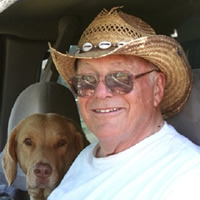
Thomas R. Cox (Charles Andreas Geyer) is Professor Emeritus of History at San Diego State University who currently lives in McCammon, Idaho, where he has an orchard of heritage apple varieties and trains dogs for field trial competition. He did field botany under the University of Washington’s Arthur Kruckeberg before graduating with a major in biology from Oregon State. He later changed his field to history and earned a PhD from the University of Oregon, where he was one of the pioneer practitioners of environmental history. He is a fellow and former president of the Forest History Society. He has published numerous articles on forest and environmental history and is the author of The Park Builders: The State Parks Movement in the Pacific Northwest; Mills and Markets: A History of the Pacific Coast Lumber Industry to 1900; and co-author of This Well‐Wooded Land: Americans and their Forests from Colonial Times to the Present. He has a forthcoming book The Other Oregon: People, Environment, History.
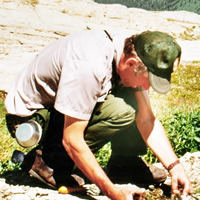
Jerry DeSanto (1928-2017) (David Lyall, Robert Statham Williams, Klaus Lachschewitz) is a retired park ranger who spent his career in Yellowstone and Glacier National Parks. His education in history, passion for plants, and deep curiosity make Jerry an ideal contributor to this book. Always recognizing those that came before, Jerry frequently and emphatically admonished his field companions with “***-it! If we’re trying to honor someone by naming a plant after them, you’ve got to pronounce their name correctly. He didn’t call himself ‘David Doug-lás’, so you can’t say ‘Doug-lás-i-a’, you’ve got to say ‘Doug-las-í-a’!” For more about Jerry, see this Kelseya article pg. 7.
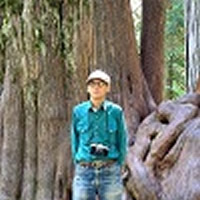
Robert Dorn (Frederick Booth) is a retired biological consultant. He has authored books on the floras of Montana, Wyoming, and the Black Hills, as well as on historical landscapes, birds, and growing native plants. For more on Dorn, see this Kelseya article pg. 3.
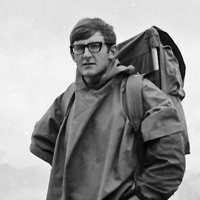
Joe Elliott (Frederick Hermann and Wilhelm Schofield) is a retired ecological consultant with more than forty years’ experience working on projects that affect natural resources in the western United States, Canada, Kenya, Ghana, Peru, and Bolivia. His work has been to gather and analyze biological information in compliance with environmental laws that address wetlands, endangered species, biodiversity, and environmental policy. He has studied with some renowned moss men and continues to be an aspiring bryologist.
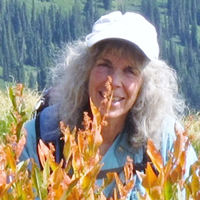
Anne Garde (Marcus Jones) is, like many of the plant hunters in this book, a self-taught botanist (with a lot of help from the Montana Native Plant Society). She loves Latin binomials and hiking in Montana woods and prairies with her eyes on the ground and a hand lens in her pocket.
Keith Gopher (Montana’s First Botanists) is a member of the Chippewa-Cree Tribe and is the tribe’s Wetland Program Manager. He works with tribal elders in addressing protection and restoration of wetland specific cultural plants and wetlands on the Rocky Boy Reservation.
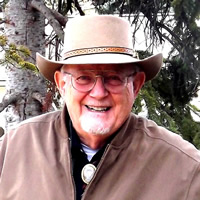
James Habeck (Morton Elrod, Joseph Kirkwood, C. Leo Hitchcock, and Frank Rose) is Professor Emeritus at the University of Montana. Since being hired in Missoula in 1960, his career has focused on vegetation ecology, including the role of fire. He taught two summers at the University of Montana Biological Station, founded by Morton Elrod in 1899. Jim’s interest in history of UM’s botany department and its faculty led him to search out archived information of the University’s first botany professors, as well as assembling and preparing written documents related to the origins of the University’s herbarium and those field botanists who make early day contributions to the herbarium holdings. Morton Elrod was identified as one of these, and the need for biographical information on Elrod led to the “life and times” compilation that is the basis for the Morton Elrod essay.
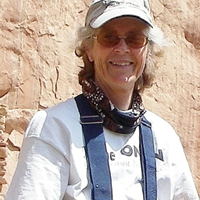
Tulli Kerstetter (Joseph Blankinship) has a Master’s degree in botany from Montana State University. Her thesis research involved verifying the taxonomic status of Erigeron lackschewitzii for the Montana Native Plant Society.
Shannon Kimball (Paul Standley) spent her childhood near and in Glacier National Park. She and colleague Peter Lesica have written two field guides to the Park’s flora some 90 years after her subject, Paul Standley, wrote the first Glacier flora. She is currently the Curator of the University of Montana Herbarium in Missoula and Treasurer of the Montana Native Plant Society.
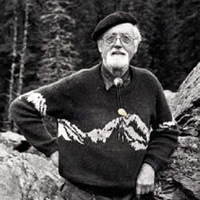
Arthur Kruckeberg (Frank Tweedy, Morton Elrod, and C. Leo Hitchcock) (1920-2016), former Professor of Botany at the University of Washington, was an activist in conservation issues, authored books and papers on plant ecology, geology, gardening and wildflowers, and was co-founder of the Washington Native Plant Society in 1976. For more, see an obituary here.
Peter Lesica, co-editor (Nathaniel Wyeth, Frank Tweedy, Sereno Watson, Francis Kelsey, John Lieberg, Pliny Hawkins, Wilhelm Suksdorf, National Youth Administration, Wilfred White, Marie Mooar and LeRoy Harvey) has been a consulting botanist and plant ecologist in Montana for the past 35 years. He has authored books on the flora of Montana and Glacier National Park.
Tara Luna (Montana’s First Botanists) lives on the Blackfeet Reservation and has worked as a botanist in Montana for 27 years. She collaborates extensively with tribes in the western U.S. on plant conservation and restoration projects of culturally significant and rare plants.
Pauline Matt (Montana’s First Botanists) is a member of the Blackfeet Tribe and has worked with traditional plant uses throughout her life. She teaches short courses on Blackfeet ethnobotany and owns a small herbal product sustainable business.
Sheila Morrison (Wally Albert) has been hiking and botanizing in Montana for decades. She has grown countless species of native plants and has authored books on trail hiking and native plant propagation. For more about Sheila, see this Kelseya article. pg. 6.

Jack Nisbet (Introduction) is a writer who focuses on the human and natural history of the Intermountain West. His books included biographies of David Thompson and David Douglas as well as essay collections that wrestle with all kinds of plants.
Wayne Phillips (Meriwether Lewis) is a retired Forest Service ecologist and charter member and former president of the Montana Native Plant Society. He is the author of three wildflower field guides: Plants of the Lewis and Clark Expedition, Northern Rocky Mountain Wildflowers, and Central Rocky Mountain Wildflowers.
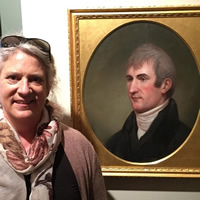
Rachel Potter, co-editor, designer (Gertrude Norton, Morton Elrod, C. Leo Hitchcock) earned a B.A. in Botany at the University of Montana in the classrooms where Elrod, Kirkwood, Hitchcock, and Harvey taught eons ago. She worked and now plays in Glacier National Park where the plants and landscape have captivated her for four decades. She lives in Columbia Falls and served for several years as the Secretary of the Montana Native Plant Society. Jerry DeSanto long fostered Rachel’s botanical pursuits, so getting Jerry’s essays published was a motivating factor for her to be involved with the book. In the photo, Rachel is next to a portrait of Meriwether Lewis in Philadelphia’s National Portrait Gallery.
Arnold Tiehm (Per Axel Rydberg) is curator of the herbarium at the University of Nevada, Reno. He has spent over 40 years exploring the backside of nowhere in Nevada, searching out its botanical gems.
Photographers and artists
Bringing the stories to life, are the photographs of Dee Linnell Blank, Matt Lavin, Maria Mantas, Cyndi Smith, Clare Beelman, Wayne Phillips, Drake Barton, Jerry DeSanto, Mary Sloan, Dee Strickler, Tara Carolin, Sue Crispin, Ann DeBolt, Dennis Divoky, Terry Divoky, Susan Fletcher, Alex Gladstone, Cathy Koot, Teresa Larson, Tara Luna, Andrea Pipp, Elena Potter, James Romo, Libby Sale, and Sandra Looman Talbot.
Graceful botanical illustrations by Dee Linnell Blank, Anne Morely, Patricia Eckels, Karen Feather, Debbie McNeil and Kim Shirley supplement those of Mary Vaux Walcott’s, which were first published by the Smithsonian more than ninety years ago.