
Where the Prairies Meet the Mountains – an introduction to using Montana native plants
Creating Native Landscapes – a comprehensive guide developed by the USDA-NRCS Bridger Plant Materials Center south of Billings
Here’s some localized information — much of it applies to more than one region:

Where can I buy native seeds and plants?
This statewide guide lists businesses and organizations where you can buy native plants or seeds. It’s updated annually to keep it current. Please don’t print it or store it locally, as it quickly becomes outdated.
Where can I see natives growing?
Find a native plant garden near you –>

Articles about native plant landscaping
Growing natives from seed, click here
- The Magic of Montana Native Plants: A Gardener’s Guide to Growing Over 150 Species from Seed, by Missoula’s Sheila Morrison — to buy the book, click here.
- Germination of Wildland Collected Seed, by Mark Majerus
- My Favorite Garden Plants, by Sheila Morrison
Using native grasses, click here
- Using Native Bunchgrasses in landscaping design
- Landscaping with Native Grasses (a document), or you can download this powerpoint by Mark Majerus
- Water-Wise Grasses: Alternatives to Kentucky Bluegrass Turf, about growing lawns suited to our dryland conditions
- Native Grass Seed Mixture Recommendations
Birds, click here
- Audubon at Home – How your decisions can impact bird conservation and the environment
- Bring Birds to your Yard with Native Plants – Click on the link, enter your zip code, and find what to plant.
General landscaping, click here
- Auspicious Beginnings, about starting a native garden site by Rebecca Durham
- Gardening in the wildland-urban interface, especially near Helena
- Growing Echinacea, by Helen Atthowe
- Natives in the Winter Garden, by Linda Iverson
- Waterwise, fire- and deer-resistant plants for Montana, from MSU Extension
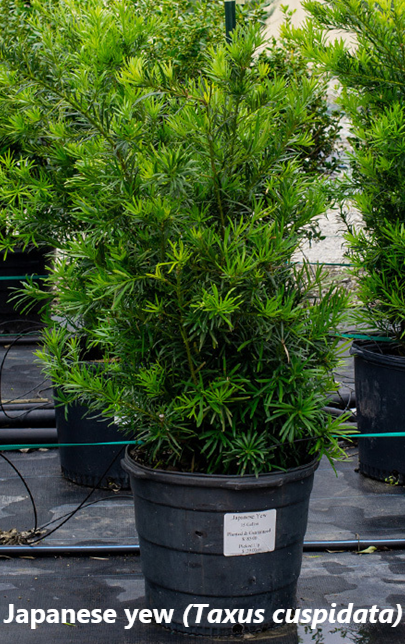
Japanese yew kills elk, moose, mule deer — poisons pets & people
Japanese yew, an evergreen, tree-like shrub native to East Asia, is popular for landscaping. Japanese yew has flat, green leaves that are darker on the top than on the bottom, with 1″ – 1.25″ needles spiraling around the stem. Female plants produce bright red berries in late summer/early fall, while male plants produce flowers that may resemble tiny Brussels sprouts. All parts of the plant are toxic.
According to Montana FWP, at least five elk calves were killed in mid-January 2025 in the Florence area of the Bitterroot Valley due to ingesting Japanese yew (Taxus cuspidata). Necropsies revealed high quantities of toxic Japanese yew in their stomachs. Several Japanese yew were in the area and had been browsed. The homeowner removed the plants.
– For more info, click here –
Japanese yew has been implicated in several ungulate die-offs associated with heavy snows:
- in Idaho in 2016-2017, resulting in the deaths of 23 elk and 50 pronghorn, as well as several yearling elk between Hamilton and Darby;
- east of Hamilton in February 2019, several yearling elk died;
- in Idaho in 2022 and 2023, two moose died after ingesting the plant.
“Because it’s not native to the area, animals aren’t familiar enough with the plant to know or teach their young that it’s toxic,” said area FWP biologist Rebecca Mowry. “Even a small amount can kill them, and yearlings are especially susceptible.” An amount less than 1 percent of an elk’s body weight is enough to cause death within 4 hours. The plant becomes especially dangerous to wildlife when heavy snows force ungulates close to homes in search of food. White-tailed deer appear to be unaffected, but mule deer are susceptible to poisoning by the plant — as are humans, pets and domestic livestock.
Please remove Japanese yew. The plant and its trimmings should be disposed of in a landfill or somewhere animals can’t access them.
Select plants carefully to conserve natives
Many plants used in horticulture and agriculture are not native to North America. The vast majority serve their purpose without problems. But a few escape cultivation and become invasive. Unfortunately, the deliberate introduction of such plants as Spotted knapweed, Dalmatian toadflax and Leafy spurge is the single most common source of noxious weeds in the USA!
Invasive exotics are a threat to Montana’s plant communities. Most nursery professionals and landscapers know this and do what they can to avoid introducing invasive plants. That’s why the Montana Landscape and Nursery Association got together with MNPS to develop voluntary guidelines to use when making recommendations to customers about which plants to select.
The Audubon Society has a very “accessible” way of describing What’s the difference between native, non-native & invasive plants?